Encircling Coils (R.C. = RIGID Coil)
This technique consists of placing the specimen inside a coil of tubular or solid construction, through which a low voltage, high amperage current is passed. The magnetic field passing through the centre of the coil - typically three or five turns - creates longitudinal magnetisation and is therefore used to detect discontinuities which lie transverse to the component’s major axis, e.g. good for detecting circumferential discontinuities in shafts or the bores of tubes.
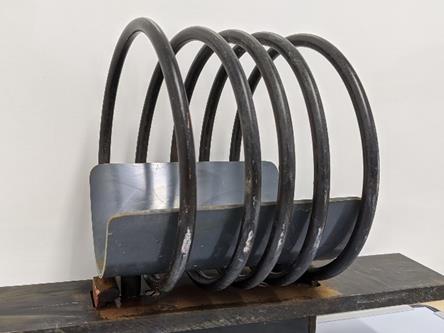
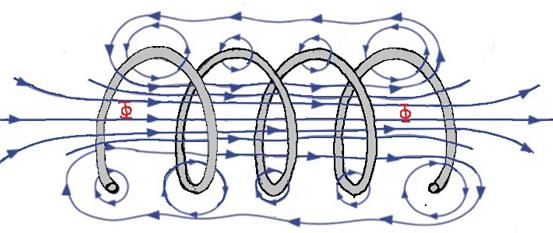
Current values for the rigid coil technique may be calculated from BS EN ISO 9934-1 using:
Where:
- NI = ampere turns
- H. = tangential field strength (kA/m)
- K. = 22,000
- L/D= length to diameter ratio of the test piece, (min 5:1, max 20:1)
Some specifications will quote the K value as 22000 if AC or FWR mean or 11000 for HWR mean or 32000 if a DC source and peak value for any waveform.
If the ratio is below 5:1, an extender bar is required. These are made from ferromagnetic material. If the L/D ratio was found to be above 20:1 (e.g. 25), the 20 should still be used to complete the calculation.
Note: For D value if not a bar
For practical purposes only discontinuities which lie within the confines of the coil should be interpreted, although the field will extend for 100 to 150 mm beyond either end.
If the specimen being tested has a small diameter in relation to the inside diameter of the coil, it should ideally be positioned close to one side of the coil and rotated to obtain the best results. The object should only occupy 10% or less of the cross sectional area of the coil (fill factor).
Note:: The strongest magnetic field is on the inside edge of the coil.
When using any of the current flow or threader bar techniques, the field strength is largely determined by the current (amperes) flowing in the circuit. When using any form of coil, the field strength is determined by the current flowing in the circuit and by the number of turns in that coil, thereby obtaining ampere turns (NI).